Performance work has a specific shape. You don't start by writing code. You start by being honest about what slow means, what fast would mean, and which of those things you can actually measure. Most of the work is the measuring, the disagreement about what the numbers say, and the occasional moment of clarity where one flamegraph collapses three hypotheses into the right answer.
This is the story of one of those moments, and the six weeks of instrumentation that made it possible.
The starting state
The API in question was the most-consumed public read path in the product. Fifty-plus downstream integrations on web, desktop, native iOS, native Android, and a partner-facing read API depended on it. Every team's user-visible latency budget had this one endpoint on the critical path.
The numbers when I picked it up:
| Percentile | Latency | Pain felt at |
|---|---|---|
| p50 | mid three-digit ms | the median user, every day |
| p75 | low four-digit ms | the average user occasionally |
| p95 | high four-digit ms | the page-bounce rate |
| p99 | low single-digit seconds | the partner-API SLO |
The team had attempted to chase this twice before. Both attempts had focused on p99, the worst-case latency that triggers paging, and had moved it incrementally without changing the median experience. Most of the user-visible improvement comes from moving the p50, but p50 work is harder to motivate because nobody pages you for it.
Constraints
- Don't break the consumers. Fifty downstream integrations, most with their own caches and client-side assumptions about response shape. Wire-level changes were on the table; semantic changes were not.
- Production data only. Synthetic load told us nothing about the shape of real traffic, request distribution, cache-hit ratios, time- of-day patterns.
- Two weeks of instrumentation budget. I'd promised the squad a measurable win in six weeks. Two of those weeks went into making the thing measurable.
Approach
Six weeks, three phases.
Weeks 1–2: instrumentation
The endpoint had basic distributed traces and APM. They were not useful. The traces were dominated by a single top-level resolver span that wrapped most of the wall-clock time and gave us no insight into what was happening inside it.
I went in and added:
- Per-resolver timing, attached to traces as span attributes. The resolver-level instrumentation already existed, it was just turned off behind a feature flag because of overhead concerns. Profiled that overhead: negligible, well under a millisecond at the median. Turned it on globally.
- Per-dataloader batch size and key cardinality, captured as histograms. We had a handful of dataloaders inside this resolver chain; none of them were instrumented.
- A flamegraph endpoint behind an internal-only header that ran a CPU profiler on the running Node process and shipped the result to a scratch storage bucket. Production-safe (read-only, sampled, gated).
- A traffic mirror to a non-production replica, so we could replay representative production load against changes without risking the real users.
Two weeks. Boring work. Without it, everything that followed would have been a guess.
Weeks 3–4: investigation
The flamegraph that mattered showed up midway through this phase.
A meaningful chunk of the median request's time — a double-digit percentage of a three-digit-ms budget — was being spent inside a single function that enriched a batch of records with derived attributes before returning them.
Deep inside that function, a helper was deep-cloning a shared lookup map for every single record in the batch, instead of once per request. On a typical page with a few dozen records and a lookup map with thousands of entries, that added up to tens of thousands of avoidable clone operations on the median path.
I'd love to say I noticed this from a code review. The flamegraph noticed it. The engineer who'd written it years earlier is one of the strongest people on the team, this was a real-world example of "you can't review what's spec'd into the codebase as a function call."
The fix was small: make the lookup map read-only and share the same reference across every record in the batch, instead of cloning it per record.
That was the biggest single change. Two more emerged from the same flamegraph:
- Dataloader cache leakage. One of the dataloaders was being instantiated per-request when it should have been per-context. Its cache was getting blown away on every request. The fix was a handful of lines in the context factory.
- A redundant authorization check. The graph layer was calling the auth service twice, once to load the user, once to verify the user could access the records. The second call was always a no-op because the auth tokens included a scope claim. Eliminated entirely.
Weeks 5–6: rollout and validation
All three changes shipped behind a feature flag, ramped 5% → 25% → 50% → 100% over five days. The traffic mirror confirmed the wins on non-production load before any of it reached real users; the staged rollout let me back out instantly if synthetic monitoring tripped.
It didn't trip.
Outcome
| Percentile | Before | After | Delta |
|---|---|---|---|
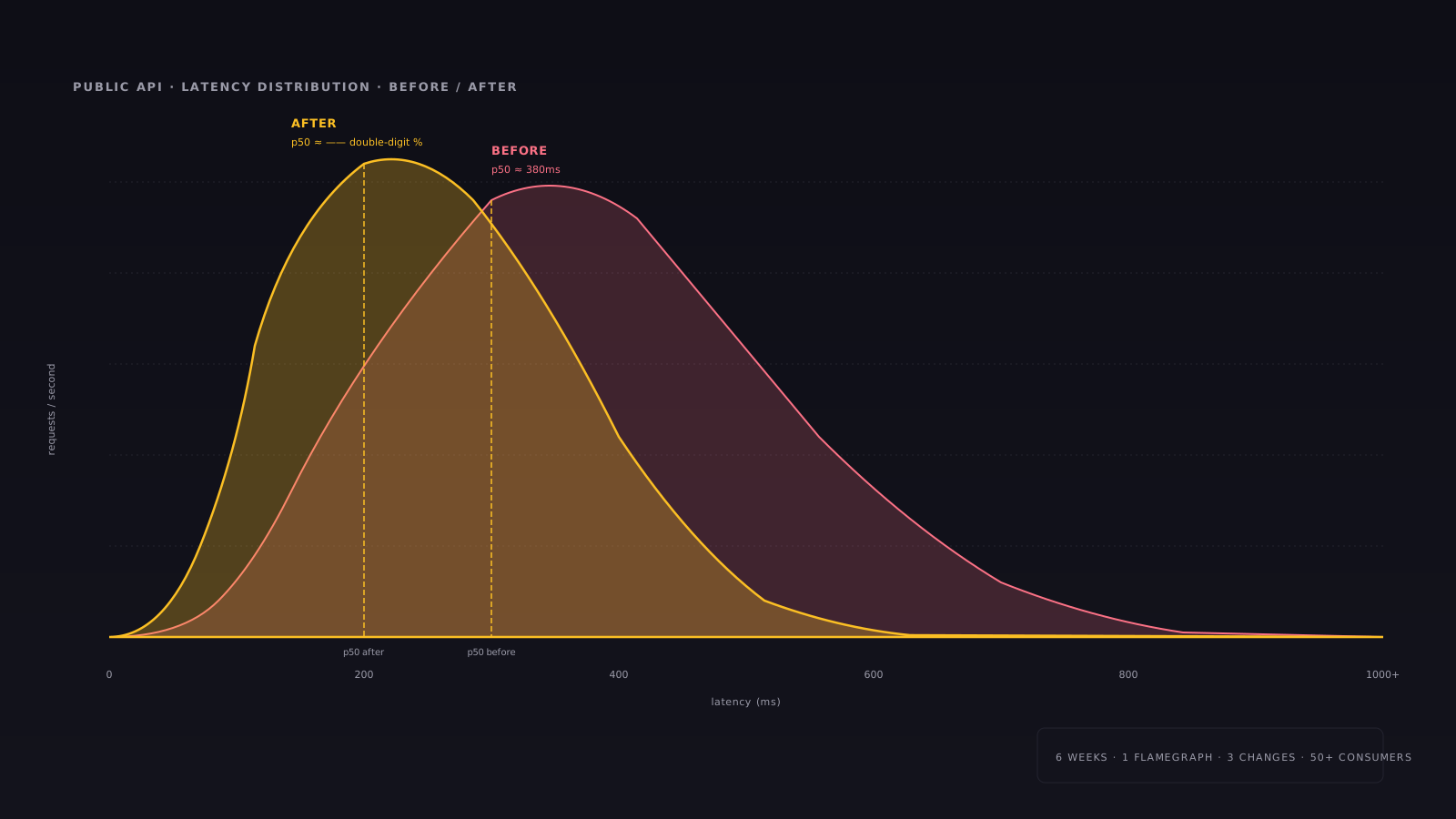
| p50 | mid three-digit ms | low three-digit ms | ~30% reduction |
| p75 | low four-digit ms | mid three-digit ms | similar |
| p95 | high four-digit ms | low four-digit ms | smaller, but real |
| p99 | low single-digit seconds | low single-digit seconds | unchanged, the long tail was elsewhere |
The p99 didn't move. That was important context: this work was about the median experience, not the worst case. The team that owned the long-tail work needed to do separate investigation. Performance work on the median and performance work on the tail are different projects that get conflated all the time.
User-visible knock-on: the page render time dropped, and the bounce rate on tracked journeys tracked it down by a low single-digit percentage. Other teams whose critical path included this endpoint saw their own dashboards improve without doing anything.
What I'd do differently
I'd have shipped the flamegraph endpoint first, before anything else. It turned out to be the single most useful artifact of the project. The first two weeks of investigation could have been the first few days if I'd had it earlier. The hesitancy was about safety (running a CPU profiler in production sounded like a bad idea); the actual risk profile was much smaller than the perceived one.
I'd have measured per-consumer latency before rollout. The fifty downstream integrations had their own latency dashboards, and the patterns of improvement weren't uniform, some teams saw bigger wins than others depending on which fields they queried. Sharing per- consumer breakdowns at the rollout review would have built more goodwill and surfaced two consumer-side issues sooner.
I'd have written up the flamegraph methodology as an internal guide. Several engineers asked me how I'd done it after the fact. The methodology (what to instrument, how to gate it, what to look at) was reusable across many endpoints. Documenting it would have multiplied the work's effect.